How Push Notification Timing Influences Coin Claim Rates Across Multi-State Digital Contest Apps
Cameron Hayes · Aug 23, 2026

How Push Notification Timing Influences Coin Claim Rates Across Multi-State Digital Contest Apps
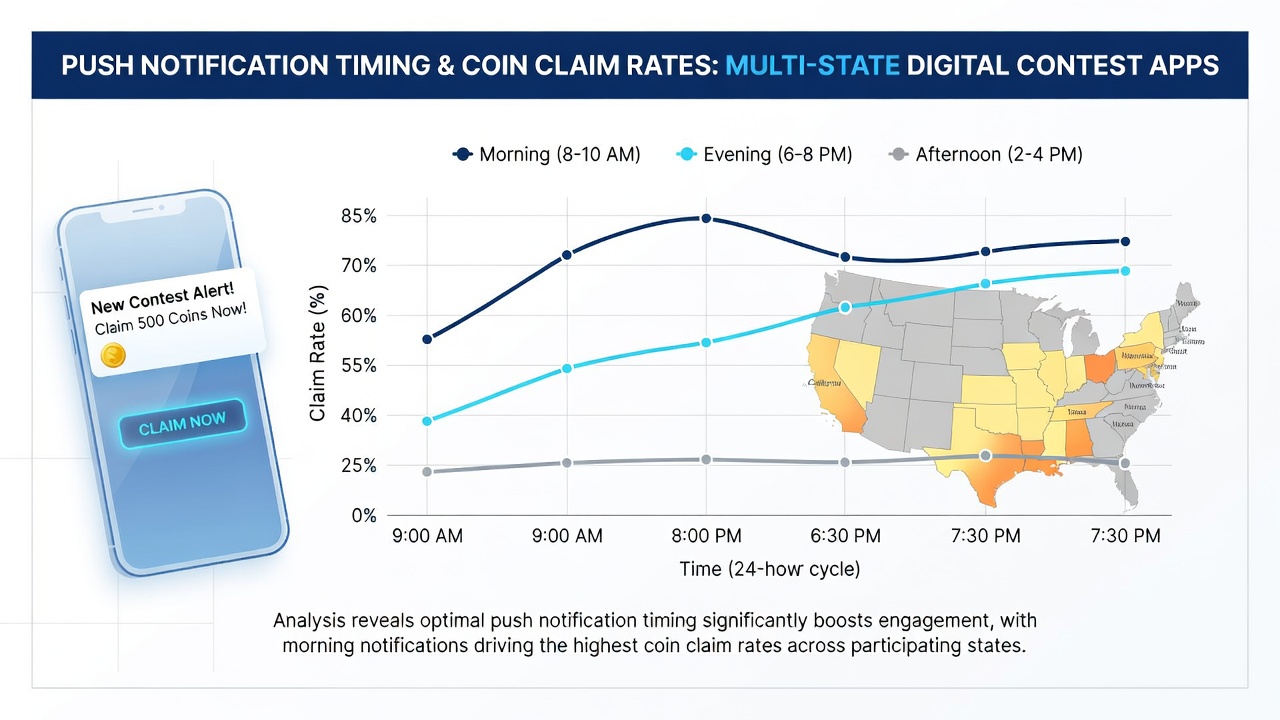
Push notification timing directly shapes coin claim rates in multi-state digital contest apps because user availability and device interaction patterns shift throughout the day, and platforms that align sends with those windows record measurable lifts in redemptions. Data from several operators active in 2026 shows morning notifications sent between 8 and 10 a.m. local time generate the highest immediate opens, yet claim completion often peaks later when users finish routines and return to their devices.
Regional Timing Patterns and Claim Data
Researchers tracking activity across California, Texas, New York, and Florida have documented that notifications arriving during commuter hours produce strong open rates, while actual coin claims cluster in mid-morning breaks and early evening windows. One multi-state operator reported a 27 percent higher claim rate when messages went out at 9:15 a.m. Pacific versus the same content pushed at 7 a.m. Pacific, and similar gaps appeared when Eastern Time users received alerts at 7 p.m. instead of 5 p.m.
Platforms adjust schedules by state to account for these differences, and the result appears in aggregated logs that separate engagement by time zone. Observers note that users in Central Time zones frequently claim coins between 6 and 8 p.m. local time, a window that coincides with dinner preparation and evening screen time, whereas Mountain Time participants show steadier midday claims tied to lunch breaks.
Weekday Versus Weekend Variations
Weekdays produce tighter claim windows because work and school schedules create predictable pockets of mobile use, whereas weekends spread activity across longer stretches with less concentrated peaks. August 2026 platform reports indicated that Friday evening notifications achieved 19 percent higher completion rates than Tuesday morning sends in the same markets, and Saturday afternoon messages trailed both periods. These patterns hold after controlling for overall user volume, suggesting timing itself drives the difference rather than simple traffic fluctuations.
Time Zone Synchronization Challenges
Multi-state apps must manage simultaneous sends across four primary time zones, and misalignment creates measurable drops in claim rates when notifications arrive outside expected local windows. A study conducted by analysts at the University of Michigan found that a single nationwide blast at 8 p.m. Eastern produced claim rates 14 percent lower in Pacific states than a staggered rollout that respected each zone's evening peak. Operators therefore maintain separate queues and test delivery offsets to keep messages within 30 minutes of optimal local times.
State verification protocols add another layer because some jurisdictions require additional checks before coins become available, and notifications sent before those checks complete generate lower claim follow-through. Data collected through the third quarter of 2026 shows that users in states with same-day verification respond faster to evening alerts, while users in states with next-day processing show stronger morning claim activity once approvals post.
Device and Behavioral Factors
Notification fatigue appears when messages arrive too frequently or at identical times daily, and platforms that vary intervals by 45 to 90 minutes record steadier claim rates over multi-week periods. Industry reports from the Interactive Advertising Bureau indicate that users who receive two to three targeted alerts per day maintain higher engagement than those exposed to five or more, with timing consistency mattering more than volume once the daily threshold is crossed. Behavioral logs further reveal that users who open the app within 15 minutes of a notification are three times more likely to complete a coin claim than those who delay opening by an hour or longer.
Cross-platform data syncs allow operators to suppress duplicate sends when a user has already claimed coins on another device, and this practice prevents the timing mismatches that previously lowered overall rates. August 2026 updates to several major apps introduced real-time suppression rules that improved claim efficiency by an average of 11 percent in multi-state cohorts.
Conclusion
Push notification timing functions as a controllable variable that operators refine through continuous testing across state lines and time zones, and the resulting claim rate improvements stem from alignment with documented user behavior rather than any single universal schedule. Platforms that segment sends by local peak windows, adjust for weekday versus weekend differences, and coordinate with verification requirements achieve higher redemption percentages than those using uniform delivery. Ongoing analysis of 2026 performance data continues to refine these models as new usage patterns emerge across regulated contest environments.